
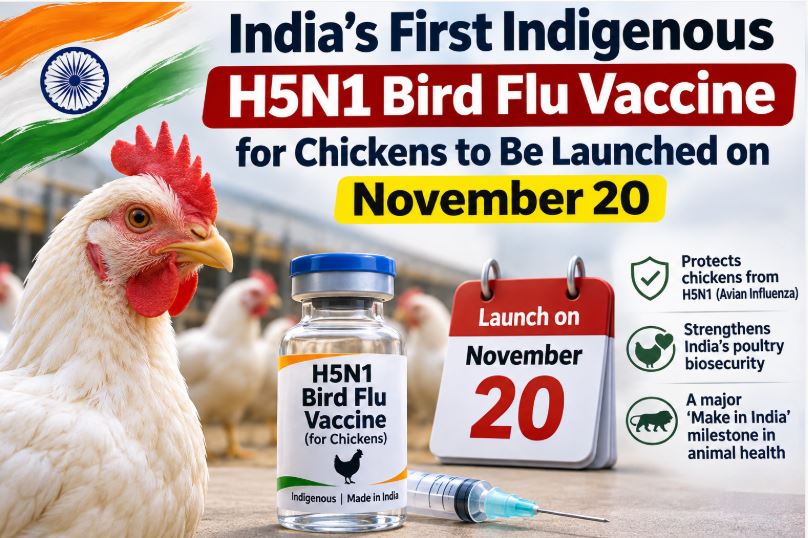
Representational Image
ICAR-NIHSAD-developed vaccine targets the H5N1 Clade 2.3.2.1a strain, offering a potential boost to poultry disease management and farmers' livelihoods
New Delhi, Nov 18: India is set to achieve a significant milestone in animal healthcare with the launch of its first indigenously developed vaccine against the highly pathogenic H5N1 avian influenza virus (bird flu) in chickens. Union Agriculture and Farmers Welfare Minister Shivraj Singh Chouhan will dedicate the vaccine to the nation on November 20 at the ICAR-National Institute of High Security Animal Diseases (ICAR-NIHSAD) in Bhopal.
Developed by ICAR-NIHSAD scientists, the inactivated vaccine specifically targets H5N1 Clade 2.3.2.1a, a viral strain responsible for a substantial proportion of bird flu outbreaks in chickens. The development marks an important step towards strengthening India's domestic capacity to tackle major poultry diseases and reducing dependence on external vaccine solutions.
Bird flu poses major threat to India's poultry sector
Highly Pathogenic Avian Influenza (HPAI), commonly known as bird flu, is among the most serious infectious diseases affecting poultry. The disease can cause mortality approaching 100 per cent among infected birds, often forcing authorities to undertake large-scale culling and impose restrictions on poultry trade.
India has reported more than 500 combined outbreaks of H5N1 and H5N8 avian influenza since the disease was first detected in the country in 2006. These outbreaks have caused substantial economic losses, affecting poultry farmers, businesses, supply chains and rural livelihoods.
The economic implications could be significant if the disease spreads extensively. According to the Ministry of Agriculture and Farmers Welfare, a major bird flu outbreak could reduce India's GDP growth by up to 1.5 per cent, while more than 20 per cent of the country's poultry population could be exposed to risk in an uncontrolled outbreak.
The 2006 outbreak alone resulted in estimated direct and indirect losses of Rs 2,200–3,000 crore. In Manipur, an outbreak caused economic losses equivalent to 0.5 per cent of the state's GDP.
Why the new indigenous vaccine matters
The H5N1 Clade 2.3.2.1a strain has emerged as a major concern because of its involvement in chicken outbreaks and its detection in several animal species, including mammals. Three human cases associated with this strain have also been reported, highlighting the importance of stronger disease surveillance and control measures.
Until now, no specific commercial vaccine has been available against H5N1 Clade 2.3.2.1a. The newly developed indigenous vaccine is intended to address this gap by providing protection against strains of the virus circulating in India.
Its development could strengthen the country's preparedness against avian influenza, support efforts to protect poultry populations and help minimise the financial burden on farmers during disease outbreaks.
A boost to animal disease preparedness
Beyond its importance for poultry farming, the vaccine represents progress in India's efforts to build indigenous scientific and technological capabilities in animal health. Strengthening disease prevention and control systems is particularly important for a country with a large poultry sector and millions of livelihoods linked to it.
The vaccine's dedication on November 20 is expected to mark an important development in India's fight against avian influenza. Its broader impact will depend on regulatory clearances, deployment strategies, vaccination protocols and integration with existing surveillance and biosecurity measures.
With this indigenous breakthrough, India is taking a significant step towards improving poultry disease preparedness, safeguarding farmers' incomes and strengthening the resilience of its livestock and poultry sector.
