
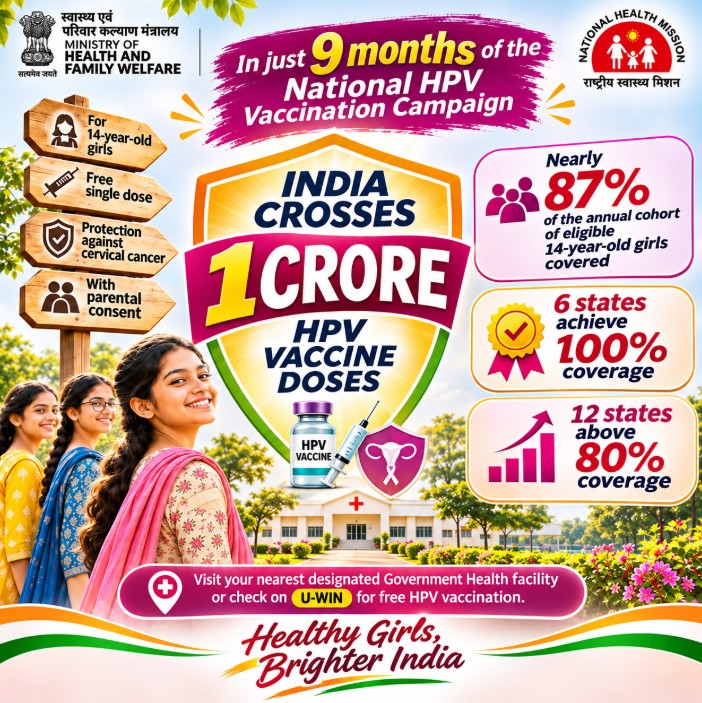
New Delhi, Nov 21: India’s campaign to shield its next generation of women from cervical cancer has crossed a major milestone, with more than one crore HPV vaccine doses administered in less than nine months. The achievement signals a significant expansion of preventive healthcare for adolescent girls and brings the country closer to its annual vaccination target.
Representational Image
The nationwide drive, launched by Prime Minister Narendra Modi in February 2026, has reached nearly 87 per cent of its estimated target cohort of 1.2 crore girls aged 14 years, according to the Union Ministry of Health and Family Welfare. The programme provides free, voluntary single-dose HPV vaccination at designated government health facilities, with parental consent.
While the one-crore mark represents a major numerical achievement, the wider significance lies in the growing reach of a preventive intervention against one of the leading cancer risks affecting women. The campaign is designed to provide protection against HPV infections that can lead to cervical cancer, years before potential exposure to the virus.
Six States Complete Identified Coverage Targets
The campaign has recorded substantial progress across the country, with six states — Gujarat, Uttar Pradesh, Andhra Pradesh, Mizoram, Madhya Pradesh and Bihar — reporting 100 per cent coverage of their identified target populations.
Among other states, Assam has achieved 95.63 per cent coverage, followed by Telangana at 95.28 per cent, Karnataka at 93.16 per cent and Uttarakhand at 90.17 per cent.
Chhattisgarh and Rajasthan have crossed 80 per cent coverage, recording 86.21 per cent and 85.23 per cent, respectively. Kerala has reported 77.02 per cent, Tamil Nadu 76.12 per cent and Odisha 74.90 per cent. Dadra and Nagar Haveli and Daman and Diu have recorded 72.99 per cent.
In absolute numbers, Uttar Pradesh has emerged as the largest contributor, with more than 29.33 lakh girls vaccinated. Bihar follows with over 13.70 lakh beneficiaries, while Gujarat has crossed 7.75 lakh.
The spread of coverage across states with different population sizes and geographical conditions points to the importance of local outreach and coordinated implementation in a nationwide public health programme.
Community Outreach at the Heart of the Drive
The vaccination campaign has relied on more than the availability of vaccines at government facilities. Its expansion has also involved district administrations, medical professionals, frontline health workers, educational institutions and local communities.
The Union Health Ministry and state governments have coordinated efforts to reach eligible girls in urban centres, rural communities and geographically difficult areas. State-level initiatives in Bihar, Tamil Nadu and Sikkim have also been integrated with the national programme.
Building parental awareness and addressing concerns about vaccine safety have remained central to the outreach strategy. Paediatricians, gynaecologists and specialists from leading medical institutions, including AIIMS, have contributed to public awareness and science-based communication.
ASHAs, Auxiliary Nurse Midwives, schoolteachers and other frontline workers have helped connect families with vaccination services, explain the purpose of the programme and counter misinformation.
This community-level engagement is particularly important for a vaccine administered during adolescence, when parental understanding and consent play a crucial role in participation.
Digital Platform Helps Identify Coverage Gaps
Technology is also supporting the campaign's implementation. The government's U-WIN digital platform enables beneficiary tracking, real-time monitoring and the maintenance of digital vaccination records.
Health officials can use the system to review progress at the district level, identify areas where coverage remains low and plan targeted efforts to reach girls who have not yet been vaccinated.
Parents can also use the platform to book vaccination slots and download digital certificates. The digital system is intended to make the process more accessible while improving transparency and programme monitoring.
Why HPV Vaccination Matters in the Fight Against Cancer
The Human Papillomavirus is a group of viruses, certain high-risk types of which can cause persistent infections that may eventually lead to cervical cancer. Vaccination against these types is considered one of the most effective ways to reduce the risk of HPV-related cervical disease.
The government's decision to focus on girls aged 14 years is intended to provide protection before potential exposure to the virus. The campaign's single-dose approach is supported by the government's stated policy for the national programme.
According to the Ministry, more than 800 million HPV vaccine doses have been administered worldwide. Nearly two decades of scientific research and real-world experience have demonstrated the vaccine's effectiveness in preventing targeted HPV infections and associated precancerous conditions.
The vaccination drive is therefore part of a longer-term prevention strategy: reducing the risk of infection today to help lower the future burden of cervical cancer.
Safety and Informed Consent Remain Priorities
The Ministry has emphasised that vaccination is voluntary and requires parental consent. Sessions are being conducted at designated government health facilities under the supervision of trained medical officers.
The facilities are linked to round-the-clock healthcare arrangements for the assessment and management of any rare adverse events following immunisation. Established safety protocols and trained medical personnel are in place to support the programme.
The emphasis on safety communication is also intended to build public confidence and encourage informed participation among families.
The Next Challenge: Reaching Every Eligible Girl
Crossing one crore doses is a landmark achievement, but the campaign's broader objective remains reaching every eligible girl across the country. With nearly 87 per cent of the estimated annual target cohort covered, the remaining challenge will involve identifying gaps, sustaining public awareness and ensuring that access does not depend on where a girl lives.
The Ministry has called on parents and guardians of eligible 14-year-old girls to approach designated government health facilities or use the U-WIN platform to obtain information and book vaccination slots.
India's HPV vaccination campaign marks an important shift towards preventing disease before it develops. Its long-term success will depend not only on the number of doses administered, but also on sustained coverage, public awareness and continued access to preventive healthcare.
The one-crore milestone is an important beginning. The larger public health goal is a future in which fewer women face the devastating consequences of cervical cancer.
