
Oct 23: Strategy is often treated as an intellectual exercise. It is developed in leadership meetings, documented in presentations, and communicated through annual plans. Yet organisations rarely struggle because they lack strategic ideas. They struggle because those ideas fail in execution. The gap between knowing strategy and operationalising it has become one of the defining leadership challenges of modern management.
For experienced managers, this creates a new expectation. They are no longer responsible only for executing functional objectives. They are expected to translate enterprise priorities into coordinated action, balance competing trade-offs, align stakeholders, and connect emerging technologies such as AI with measurable business outcomes. Building that capability requires more than learning strategic frameworks. It requires practising strategy in environments that reflect the complexity of real business.
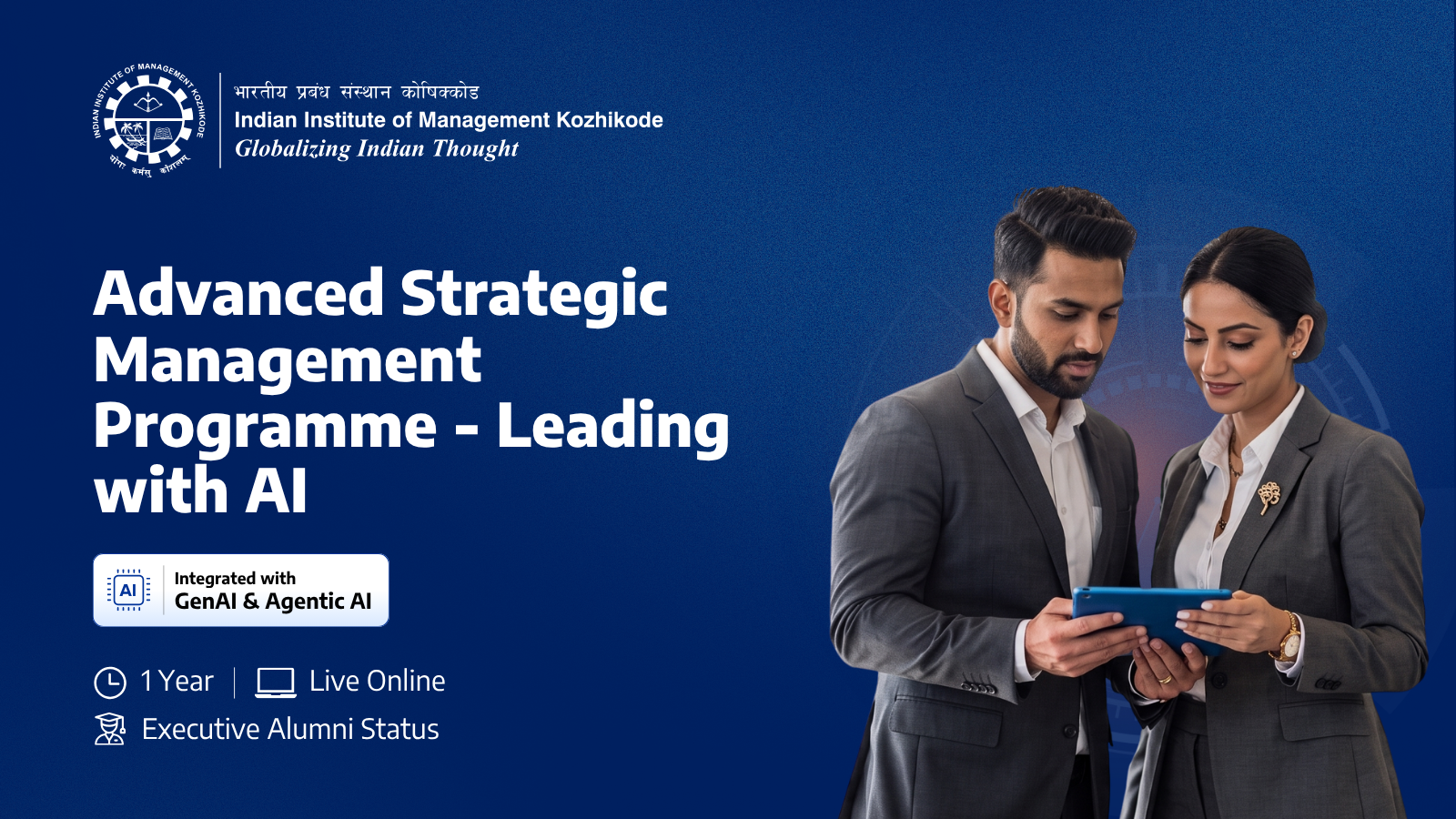
This is why executive education is increasingly shifting towards applied learning. Rather than focusing solely on strategy frameworks, executive experiences such as the Indian Institute of Management Kozhikode's Advanced Strategic Management Programme – Leading with AI are creating opportunities for professionals to test decisions, challenge assumptions, and experience the consequences of strategic choices before making them in their organisations.
Here are five ways managers can put strategy into practice.
1. Build a Holistic View of Business
Strategic decisions rarely belong to one function alone. A pricing decision affects margins, customer demand, operations, and long-term growth. A technology investment influences finance, talent, customer experience, and execution.
Managers who consistently make better strategic decisions are those who understand how functional choices create ripple effects across the enterprise. Building this systems perspective allows leaders to balance competing priorities rather than optimise individual departments in isolation.
2. Develop Judgement Through Business Cases
Reading about successful companies is very different from making decisions under uncertainty.
Case-based learning encourages managers to evaluate incomplete information, weigh competing priorities, and defend strategic recommendations. Rather than searching for a single correct answer, professionals learn how to exercise judgement when commercial, operational, financial, and organisational considerations compete.
3. Experience Strategy Through Business Simulations
Business strategies unfold in dynamic environments where market conditions, competitors, customer behaviour, and technology continue to evolve.
Business simulations recreate these realities, allowing managers to test decisions, respond to disruption, and adapt strategies as new information emerges. They provide a practical understanding of how strategic choices influence business outcomes over time rather than in theory alone.
4. Learn How AI Shapes Strategic Decisions
AI is rapidly becoming part of enterprise strategy, yet many organisations still approach it as a technology initiative rather than a business capability.
For managers, the challenge is not simply understanding AI tools but knowing where AI creates measurable business value, how it reshapes operating models, and what trade-offs accompany digital transformation. Strategic leaders increasingly need to evaluate AI through commercial, organisational, and competitive lenses rather than technological ones alone.
5. Build Decision Intelligence Through Hands-On Application
Ultimately, strategy becomes meaningful only when it is applied to real business challenges.
Hands-on projects allow professionals to test strategic frameworks against complex problems, evaluate competing priorities, develop evidence-backed recommendations, and understand how strategic choices translate into execution and business outcomes.
Strategy Is Built Through Practice
As organisations become more interconnected and AI reshapes competitive advantage, strategy is increasingly defined by execution rather than intent.
This is where applied executive learning becomes valuable. Learning opportunities such as IIM Kozhikode’s Advanced Strategic Management Programme – Leading with AI gives experienced professionals an opportunity to work through business cases, simulations, and hands-on strategic challenges that mirror the complexity of enterprise decision-making. By connecting strategy with finance, analytics, innovation, digital transformation, and AI, the learning journey helps professionals develop a broader lens for evaluating trade-offs and translating strategic choices into action.
Ultimately, moving into broader strategic responsibilities does not mean leaving functional expertise behind. It means building on that expertise to understand how decisions affect the wider enterprise, align competing priorities, and create sustainable business value. As the boundaries between functions continue to blur, the ability to connect insight with execution may become one of the most important capabilities for managers preparing to lead at scale.

