
New Delhi, Nov 27: Researchers from Bengaluru's Centre for Nano and Soft Matter Sciences (CeNS), in collaboration with the Indian Institute of Technology (IIT) Delhi, have developed a new technology that could pave the way for more stable, adjustable and cost-effective white light-emitting diodes (WLEDs).
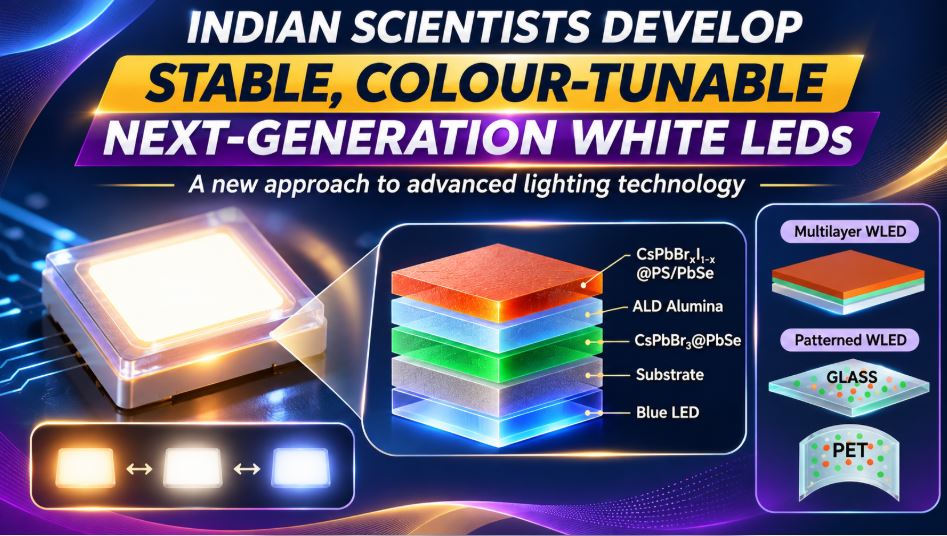
The innovation addresses a major limitation of halide perovskite nanocrystals, a promising material for next-generation lighting and display technologies. The researchers have developed a dual-protection method to prevent colour mixing, a problem that has so far affected the stability of these materials.
The breakthrough could support the development of energy-efficient white-lighting devices for homes, smartphones and other electronic applications, including flexible lighting systems.
Two-layer protection prevents colour mixing
All-inorganic halide perovskite nanocrystals, represented by the chemical formula CsPbX₃, where X can be chlorine, bromine or iodine, are attracting scientific interest because of their bright and pure colour emissions. However, combining nanocrystals that produce different colours can lead to an unwanted reaction known as anion exchange.
During this process, halide ions migrate between neighbouring nanocrystals. For example, green-emitting CsPbBr₃ and red-emitting CsPbI₃ can exchange ions, causing their original colours to shift towards an unwanted orange shade. This colour degradation can occur within minutes.
To overcome the problem, the research team adopted a two-step protection strategy.
First, the scientists used lead selenide to reduce halide vacancies on the nanocrystal surfaces. This helped eliminate a major pathway for ion movement without compromising the brightness or colour quality of the material.
In the second step, they applied an ultra-thin protective coating of aluminium oxide, also known as alumina, using atomic layer deposition. Measuring approximately 5 to 6 nanometres, the transparent coating acts as a physical barrier, restricting ion diffusion between neighbouring colour-emitting layers.
Flexible LEDs demonstrate stable performance
Using spray coating and micropatterning techniques, the researchers fabricated multi-layered white LED devices on conventional glass as well as flexible polyethylene terephthalate (PET) substrates.
The optimised devices demonstrated continuous operation for up to 24 hours while maintaining stable white-light emission. Their colour performance remained close to ideal white light even under heating and cooling conditions.
Another notable feature is the ability to adjust the white-light tone by changing the electrical current. This could allow the same lighting technology to produce different shades, including warmer or dimmer white light, offering greater flexibility in lighting applications.
The findings have been published in the scientific journal Small under the title associated with DOI: 10.1002/smll.202512820.
Lead toxicity remains a challenge before commercial use
Despite the promising results, the technology requires further development before it can be considered for widespread commercial applications. The use of lead-based perovskite materials raises environmental and health concerns, making toxicity management and the development of more eco-friendly alternatives important areas for future research.
The study represents a step towards scalable and potentially lower-cost lighting technologies that can be manufactured on both rigid and flexible surfaces. If the remaining material-safety challenges are addressed, the approach could open new possibilities for next-generation LEDs and display devices.
The research was conducted by Gauri Sharma, Swati Khurana, Sameer Sapra and Pralay K. Santra at CeNS, an autonomous institute under the Department of Science and Technology, Government of India, in collaboration with IIT Delhi.

