National Institute of Securities Markets (NISM), an institution established by the Securities and Exchange Board of India (SEBI), has entered into a collaboration with Galgotias University to strengthen professional learning opportunities in securities markets, financial services, derivatives, investment ecosystems, fintech, and risk management.
 |
SEBI’s NISM and Galgotias University join hands to strengthen fintech, capital markets, and industry-aligned financial learning for students
Finance, technology, artificial intelligence, analytics, digital payments, and investment platforms are increasingly intersecting across industries and startup ecosystems. Companies today require graduates who understand markets, regulation, financial instruments, investment behaviour, and capital flows alongside technology and business fundamentals.
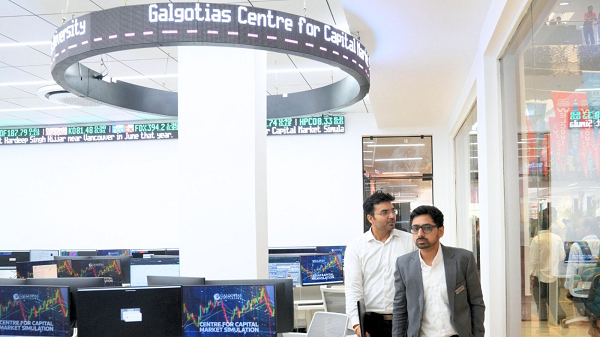
Galgotias University has been strengthening its business, entrepreneurship, and fintech-oriented academic ecosystem through industry-linked programmes, startup engagement, interdisciplinary learning, and applied training initiatives. The University’s School of Business and the Centre for Capital Market Simulation contribute to this focus by creating stronger exposure to financial systems, market behaviour, and investment ecosystems among students. Housed within the School of Finance and Commerce, the Centre features the NSE SMART Lab established in collaboration with NSE Academy, where students engage with capital market concepts, trading environments, and simulation-based financial learning on the NSMART platform through exposure to real-time market scenarios in a risk-free academic setting.
The collaboration is expected to benefit students across multiple disciplines including business, commerce, economics, management, engineering, computer science, artificial intelligence, and analytics domains. Students building startups or technology-led ventures can particularly benefit from stronger exposure to financial systems, investment structures, market dynamics, and regulatory frameworks that influence scalability, fundraising, and long-term business growth.
Under the collaboration, students will gain access to NISM certifications, e-learning modules, certification-linked learning pathways, and academic support in areas including securities markets, mutual funds, equity derivatives, investment advisory, merchant banking, portfolio management services, research analysis, securities operations, and risk management.
Speaking on the collaboration, Dr. Dhruv Galgotia, Chief Executive Officer, Galgotias University, said, “Technology and finance are increasingly converging across sectors, whether in digital payments, fintech platforms, investment ecosystems, analytics, or startup environments. Students today require a stronger understanding of financial systems and market structures irrespective of their discipline. A technology founder, for example, may build a strong product but still require deeper understanding of capital markets, investment behaviour, regulatory systems, and financial strategy to scale effectively. Our collaboration with NISM will help students build this exposure through structured certifications, applied learning, and engagement with the financial sector.”
Under the understanding, NISM will support participating students and faculty through learning resources, e-learning programmes, faculty development modules, assessment support, and expert engagement opportunities. Faculty development programmes, expert-led sessions, and academic integration support will also form part of the engagement.
The collaboration further strengthens Galgotias University’s focus on industry-linked learning, interdisciplinary capability building, and preparing students for opportunities emerging across financial services, fintech, analytics, consulting, investment research, and capital markets.