Goa, Aug 20: In multi-institutional research, Goa Institute of Management, in collaboration with the Gokhale Institute of Politics and Economics, Pune, has conducted a study examining parental awareness and responses to “Technology-Facilitated Gender-Based Violence” in the generative AI era
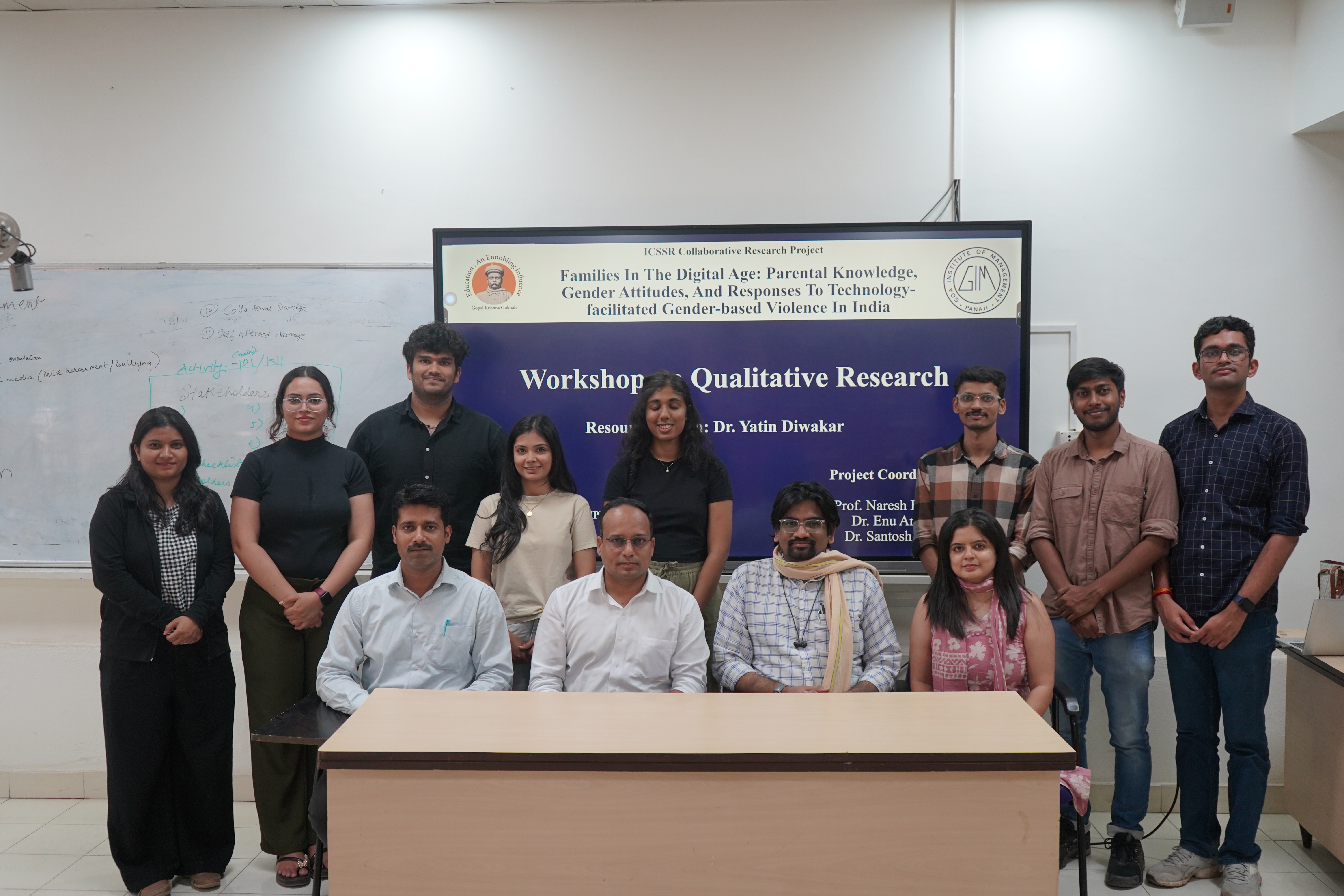
Funded by the Indian Council of Social Science Research, the study was conducted by Prof. Enu Anand, Assistant Professor, Centre for Social Sensitivity and Action, GIM, in collaboration with Prof. Naresh Bhodke and Prof. Santosh Phad, Assistant Professors, Gokhale Institute of Politics and Economics, Pune. The study analysed 40 in-depth interviews using 100 thematic codes, covering parents, young adults, educators, content creators, elderly citizens and other stakeholders across urban, semi-urban and rural areas of Pune, Maharashtra.
Other members of the research team included Mr. Kapil Gaikwad, Mr. Haardhi Palrecha, Mr. Ashish Sharma, Mr. Akshay Shinde, Ms. Rumela Pani, Ms. Shreya Dikshit, and Mr. Prathamesh Parulekar.
Based on the data recorded, the research team found that while most participants had heard of deepfakes and AI-enabled harms, very few knew how to identify manipulated content and respond to such incidents.
Speaking about the relevance of this study, Prof. Enu Anand said,
“Gender-based violence has moved online, and generative AI has sharply worsened it. Anyone can now morph a photograph or create a synthetic video, and it is often impossible to tell what is real. Families, especially in rural areas, are simply not prepared for this. That is why safeguarding girls and women can no longer stop at platforms and law; it has to reach the home itself. When parents understand how these tools create and circulate deepfakes, they can protect their children before the harm is done."
The digital safety conversation in India has focused on platforms and law, but the first response to online harm happens at home, and our research shows how unequally equipped families are for it. Awareness was highest among urban and educated parents, and thinnest exactly where support is scarcest: among rural, older, and first-generation internet users. If policy continues to assume that families understand TFGBV and already know what to do, it will miss out on many. What we need is digital safety education built for households that is gender-inclusive and targets people from all backgrounds.
Key findings of the study included:
·Awareness of AI-enabled harm is uneven: participants were far more alert to financial fraud, such as voice cloning and OTP scams, than to technology-facilitated gender-based violence like deepfakes and image morphing. This makes financial fraud, already familiar to most families, a practical entry point for building wider awareness of AI-enabled abuse
· Children and younger adults have more digital knowledge than their parents, resulting in intergenerational digital knowledge gaps.
· Parents may see bans and consequences for online activities as ways to punish or control their children. This can result in children avoiding reporting such incidents.
·Girls and women face systemic issues that boys and men do not face to the same extent. These include victim blaming, excessive surveillance, and additional restrictions on digital activities.
·Turning 18 often marks a reduction in parental supervision while exposure to harmful online activities increases.
·Digital content creators are targeted through trolling, reputation attacks, and image misuse.
·Cybercrime reporting is considered necessary but difficult.
Speaking about the research findings, Prof. Santosh Phad said,
“Parents are expected to be the first line of digital defence, but children are increasingly becoming the source of digital knowledge within families. This creates a clear intergenerational digital knowledge gap, with many parents lacking the digital skills needed to identify and respond to online harms. The study also shows that rural and urban families face very different digital-safety conditions. While urban families have relatively greater access to digital knowledge and institutional resources, rural families often rely on physical restrictions, community surveillance and traditional family authority, which offer limited protection against less visible technology-facilitated harms.”
The study shows why it is important to go beyond simple digital safety education and focus on providing digital safety education that incorporates both preparedness and the willingness to act. It also focuses on the importance of developing AI and digital safety skills for parents to help them identify risks before their children do.
It calls for intervention from policymakers and relevant stakeholders to prioritise the digital safety of children and young adults who are vulnerable to such incidents. These experiential, data-driven findings can contribute to the development of more inclusive, family-centred digital safety initiatives.