
Hyderabad, Nov 16: Birla Institute of Technology and Science Pilani, Hyderabad Campus researchers have developed a desalination and cooling system that can produce freshwater from brackish water/seawater while delivering cooled, dehumidified air. The developed innovation addresses freshwater scarcity and the growing need for cooling in hot environments, two challenges often faced by coastal communities.
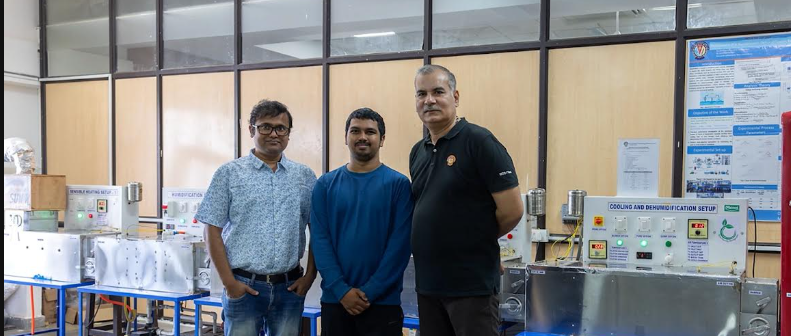
The research team has secured an Indian patent titled “Portable solar-powered desalination apparatus and solar-powered method of desalinating water and cooling an environment simultaneously” for the developed technology.
Unlike conventional approaches that typically treat desalination and cooling as separate functions, the developed system heats ambient air and passes it through a humidification unit, where moisture from saline or brackish water is added to it. This moisture-rich air is then cooled, allowing the water vapour to condense and be collected as freshwater. The resulting cooled, dehumidified air can be used for suitable cooling applications.
Led by Prof. Sandip S. Deshmukh and Prof. Santanu Prasad Datta of the Department of Mechanical Engineering, along with Mr. K. Sai Sandeep, Research Scholar at BITS Pilani, Hyderabad Campus, the research team has developed a lab-scale prototype to evaluate its performance across different seasons under actual ambient conditions.
The developed prototype supports five operating configurations, allowing the balance between freshwater production, cooling, and energy consumption to be adjusted according to climatic conditions and application requirements.
In the lab scale tests, the research team noted that –
- Under high-humidity conditions, the system recorded a maximum freshwater production rate of approximately 12.4 litres per hour in its double-stage configuration with water heating.
- Experiments also demonstrated a cooling capacity of up to 6.57 kW, with outlet air temperatures as low as 14°C, depending on the operating configuration.
The prototype has been developed around a target freshwater production scale of approximately 200 litres per day for diverse Indian climatic conditions. The developed innovation can be used in geographies such as coastal and island communities, where access to freshwater and cooling is particularly challenging.
Speaking about the findings, the research team said,
“Our lab-scale tests indicate that different operating configurations offer different advantages. While multi-stage operation can increase freshwater production, dehumidification-based configurations offer stronger cooling performance.”
The research team has also evaluated the developed technology for its economic and environmental performance. In lab-scale tests, the lowest estimated freshwater production cost was recorded at Rs. 0.30 per litre.
The findings of this research have been published in the prestigious Applied Thermal Engineering journal.
As the next step, the team plans to adapt the technology to different climatic conditions and evaluate its performance through field trials. Additionally, the research team is also exploring potential industry collaborations for pilot deployment and further development.
