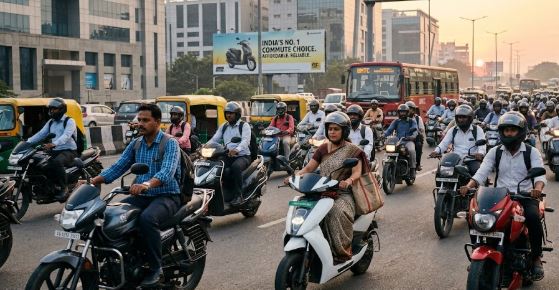
For millions of Indians, getting to work is increasingly a two-wheeler journey. The country's first-ever National Household Travel Survey (NHTS) has highlighted just how important motorcycles and scooters have become in everyday workforce mobility, particularly in urban areas.
According to the survey conducted by the National Statistical Office (NSO) during July 2025-June 2026, 42.6 per cent of workers who travelled to fixed or non-fixed workplaces used two-wheelers as their primary mode of transport. The share was significantly higher in urban India at 52.3 per cent, compared with 37.1 per cent in rural areas.
The numbers offer a clear picture of why two-wheelers continue to hold such a strong position in India's mobility landscape. They combine relatively low ownership and running costs with the flexibility to navigate congested roads, cover last-mile distances and reach workplaces that may not be directly connected by public transport.
The cost of getting to work
The NSO survey estimates that workers travelling to a fixed workplace spend an average of ₹785 a month on commuting. However, the cost varies considerably between urban and rural India.
Urban workers spend an average of ₹1,044 per month, while the corresponding figure for rural workers is ₹612. Male workers spend an average of ₹835 per month on fixed-workplace commuting, compared with ₹533 for female workers.
For households managing monthly budgets carefully, transportation is therefore more than a convenience — it is a recurring cost directly linked to employment.
The relatively modest average spending also helps explain the continued popularity of motorcycles and scooters. For many workers, owning a two-wheeler provides greater control over daily travel expenses and eliminates dependence on fixed public-transport routes and schedules.
Urban India leans more heavily on two-wheelers
The difference between urban and rural mobility patterns is particularly striking.
While walking remains a major mode of travel in rural areas, urban workers increasingly depend on motorised personal mobility. The NSO survey shows that two-wheelers account for more than half of workplace trips among urban workers.
Cars, by comparison, account for just 5.7 per cent of urban worker commutes, while buses account for 9.2 per cent and trains, monorails and trams together account for 5 per cent.
This suggests that two-wheelers are filling an important middle ground between walking and public transport — particularly for workers who need to travel beyond walking distance but may not have convenient access to mass transit.
A market built around everyday mobility
The strength of commuter demand is also reflected in India's two-wheeler market. JATO Dynamics reported around 1.82 million two-wheeler registrations in July 2026, up 28.15 per cent from the same month a year earlier. The growth was supported by demand for commuter vehicles and improving consumption conditions.
India's two-wheeler industry remains one of the world's largest, with domestic sales reaching around 20 million units in FY2025. Two-wheelers accounted for about 76.3 per cent of India's total automobile sales volume that year, underlining their importance to personal mobility.
Their popularity is not difficult to understand. Lower purchase costs, better fuel efficiency, comparatively affordable maintenance, easier parking and the ability to move through crowded streets make motorcycles and scooters practical for daily commuters.
The time factor matters too
Money is only one part of the commuting equation. Time is equally important.
The NSO survey found that the average travel time for workers travelling to a fixed workplace was 25 minutes. Around 83.4 per cent of workers reached their workplace within 30 minutes, although urban workers recorded a higher average travel time of 27 minutes compared with 23 minutes in rural areas.
The morning rush is concentrated heavily in the early part of the day, with nearly 95 per cent of workers leaving for work before 10 a.m. This makes flexibility particularly valuable for employees travelling during peak traffic hours.
What the numbers mean for India's mobility future
The survey provides an important signal for policymakers and businesses. India's mobility challenge is no longer simply about building more roads. It is about creating an integrated transport system that accommodates personal vehicles while expanding affordable, reliable and efficient public transportation.
NITI Aayog estimates that two-wheelers accounted for 167 vehicles per 1,000 people in India's private vehicle ownership in 2023, compared with 30 cars per 1,000 people. It has also highlighted the need for stronger public transport, first- and last-mile connectivity and shared mobility as vehicle ownership rises.
This could create opportunities across several areas — from electric two-wheelers and charging infrastructure to better roads, parking systems, public transport integration and digital mobility services.
The rise of electric scooters could also gradually change the economics of daily commuting. As electric mobility expands, commuters may have more options to reduce fuel-related expenses while cities work towards cleaner transportation.
Two-wheelers are more than a vehicle
The NSO findings ultimately reveal something simple but important: for a large section of India's workforce, mobility is closely tied to affordability, convenience and access to employment.
A motorcycle or scooter is not merely a personal vehicle. For many workers, it is the link between home and livelihood — offering the freedom to leave when needed, choose a route and reach workplaces that may otherwise be difficult to access.
As India's cities expand and employment becomes increasingly distributed across urban and suburban areas, this role is likely to remain significant. The challenge ahead will be to ensure that the country's growing dependence on personal mobility is matched by safer roads, better public transport and cleaner transportation choices.
India's commuting story, therefore, is not simply about two-wheelers dominating the roads. It is about how millions of workers are balancing time, cost and convenience every day to stay connected to work and opportunity.
