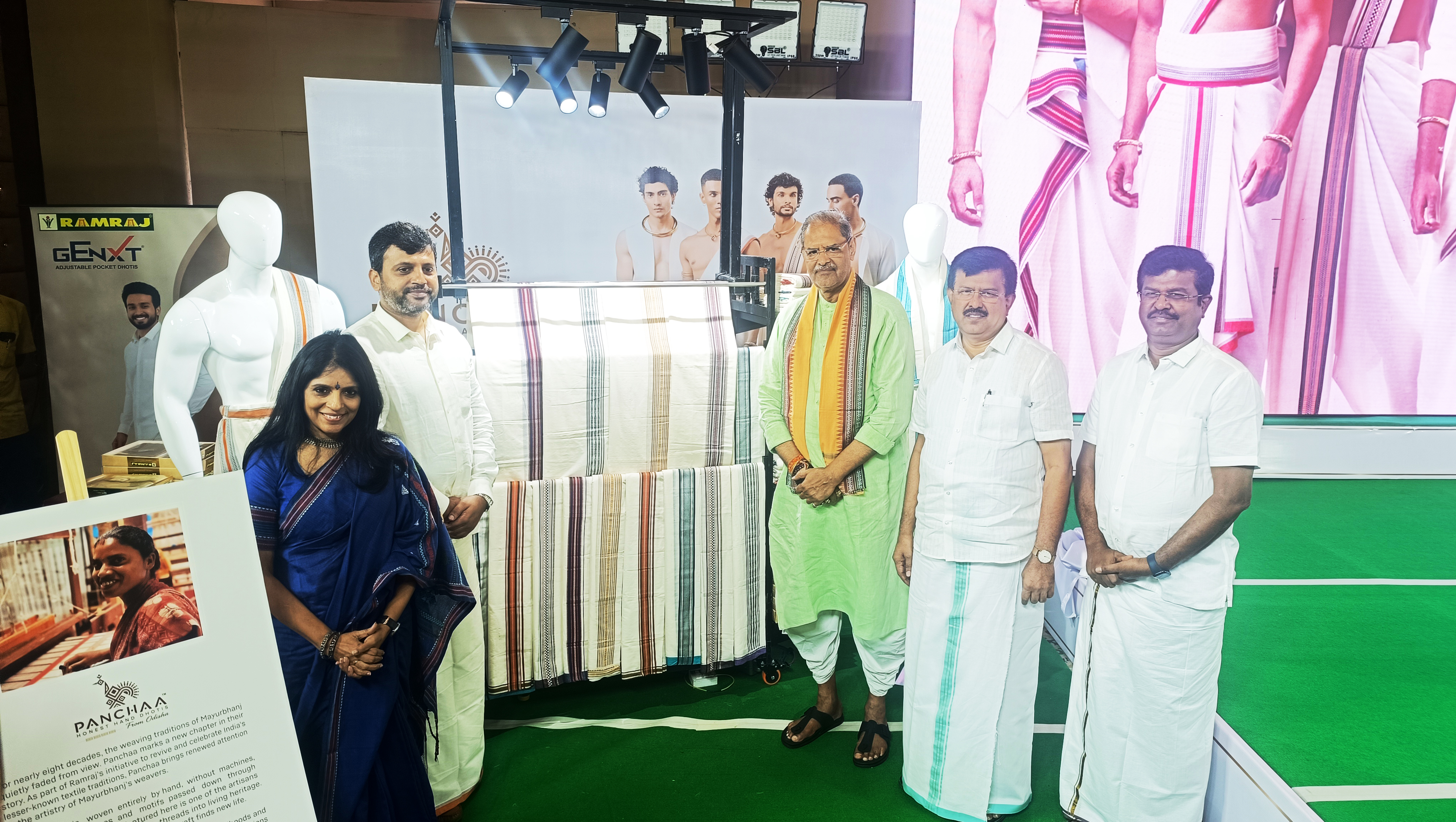
Bhubaneswar, Aug 12: Ramraj Cotton today unveiled Panchaa in Odisha, bringing its new handloom offering home to the very soil it draws its identity from. Panchaa™ reimagines the traditional Santhali weave of Mayurbhanj as a contemporary Dhoti, carrying the state's indigenous textile heritage from the villages of Mayurbhanj into the wardrobes of contemporary India. The Odisha unveiling took place at a special event in Bhubaneswar in the presence of Mr. Kanak Vardhan Singh Deo, Hon'ble Deputy Chief Minister of Odisha, as the Chief Guest, Ms. Bindu Vinodhan, Founder of the Mauna Dhwani Foundation, as the Guest of Honour, and Mr. B.R. Arun Eashwar, Managing Director, Ramraj Cotton. Notably, the event was graced by representatives of the tribal women weavers of Mayurbhanj district, whose generations-old craftsmanship forms the very foundation of Panchaa making this Odisha unveiling as much a tribute to their heritage as it is a celebration of the product itself.
Panchaa will be available at select Ramraj Cotton Exclusive Stores and online at www.ramrajcotton.in/collections/panchaa-handwoven-dhotis. Commenting on the launch, The Culturepreneur, K.R. Nagarajan, Founder & Chairman, Ramraj Cotton, said: "It is a privilege to unveil Panchaa™ here in Odisha, the birthplace of the beautiful Santhali weave of Mayurbhanj, and to do so in the presence of the women weavers and artisan communities who have preserved this remarkable tradition for generations. Today is not just the launch of a new Dhoti, but a celebration of their craftsmanship, dedication and cultural heritage. At Ramraj Cotton, we believe that India's rich textile traditions deserve to be seen, valued and worn by more people. Through Panchaa™, we have respectfully reimagined this unique weave in a contemporary form while staying true to its authenticity. We hope this initiative brings greater recognition to the craft, creates meaningful livelihood opportunities for the weaving community, and encourages future generations to continue this proud legacy.
"Speaking at the event, Mr. B.R. Arun Eashwar, Managing Director, Ramraj Cotton, said: "For us, Panchaa™ is not just a product launch, it is a livelihood revival model. Our approach was to build a viable commercial pathway for this heritage by converting the weave into a Dhoti, one of the most consistently in-demand garments in India. Apart from being known for its quality products, Ramraj Cotton has long been known for sustaining the livelihoods of thousands of weavers across South India. The launch of Panchaa is our commitment to carry this same responsibility forward, and build livelihoods for weaver communities beyond South India as well."
Panchaa reflects Ramraj Cotton's continued commitment to bringing India's lesser-known weaving traditions into the mainstream while creating renewed recognition and sustainable livelihood opportunities for the tribal women weavers who have preserved this unique craft across generations.
Traditionally woven as sarees by women of the Santhali tribal community in Mayurbhanj, this distinctive weave has gradually faded from prominence over the decades due to declining patronage, changing lifestyles and limited market opportunities. Recognising both its artistic value and its potential for contemporary relevance, K.R. Nagarajan, Founder & Chairman, Ramraj Cotton, reimagined the Santhali weave in the form of a Dhoti through Panchaa™, creating a new avenue for the craft while preserving its authenticity.
Panchaa retains the traditional character of the weave while giving it a wider contemporary relevance. Each piece is handwoven in 100% cotton with an off-white base and azo-free dyes, combining a plain weave with an extra-weft technique, a reflection of the remarkable skill and craftsmanship of the women weavers who continue to practise this generations-old tradition. Panchaa has been developed in close collaboration with the weaving communities of Mayurbhanj, ensuring that the traditional techniques, motifs and identity of the craft remain intact while introducing the weave to a wider audience through one of India's most iconic garments.
