
43 in 100 want to start a business, 22 have already started and 8 already earn regular sales, on par with global averages. More students now want to start up right after college, and fewer want a government job.
Mandi, Octo 21: More than one in five Indian college students has already started a business, on par with the global average, according to the GUESSS India 2025 National Survey Report released by the Indian Institute of Technology Mandi, in partnership with REVA University, Bangalore. The survey of 25,783 students from more than 1,200 higher-education institutions in 34 states and union territories finds that 43 in 100 Indian students want to start a business, the same as the global average. Of those who start, 35.5% already earn regular sales.
More students now want to start up straight after college. The share who want to run their own business right after their studies rose from 14.0% in the 2023 survey to 16.2% in 2025. Over the same period, the share who want a government job right after studies fell from 12.7% to 10.1%, and the share who want a job in a large company fell from 31.3% to 27.4%.
India's student founders are also quick to act and quick to try again. 31% of student businesses with regular sales were founded in 2025 alone. 41% of their founders have already closed an earlier business and started again, and 42% run two or more businesses.
"India's students are as ambitious as any in the world, and those who start are building real businesses that already hire people," said Dr. Puran Singh, Associate Professor at the School of Management, IIT Mandi, and Country Delegate for GUESSS India, who led the report. "Courses, dedicated programmes and campus incubators are clearly working. The opportunity now is to put more founders in students' lives and help them take a real first step early. Then we count how many students move from ambition to action; not just how many talk about creating a startup."
The findings show that IT, AI and digital is the most common plan by student founders, but only about one in ten running student businesses is digital. Further, students with founders in their circle are three times more likely to start a venture.
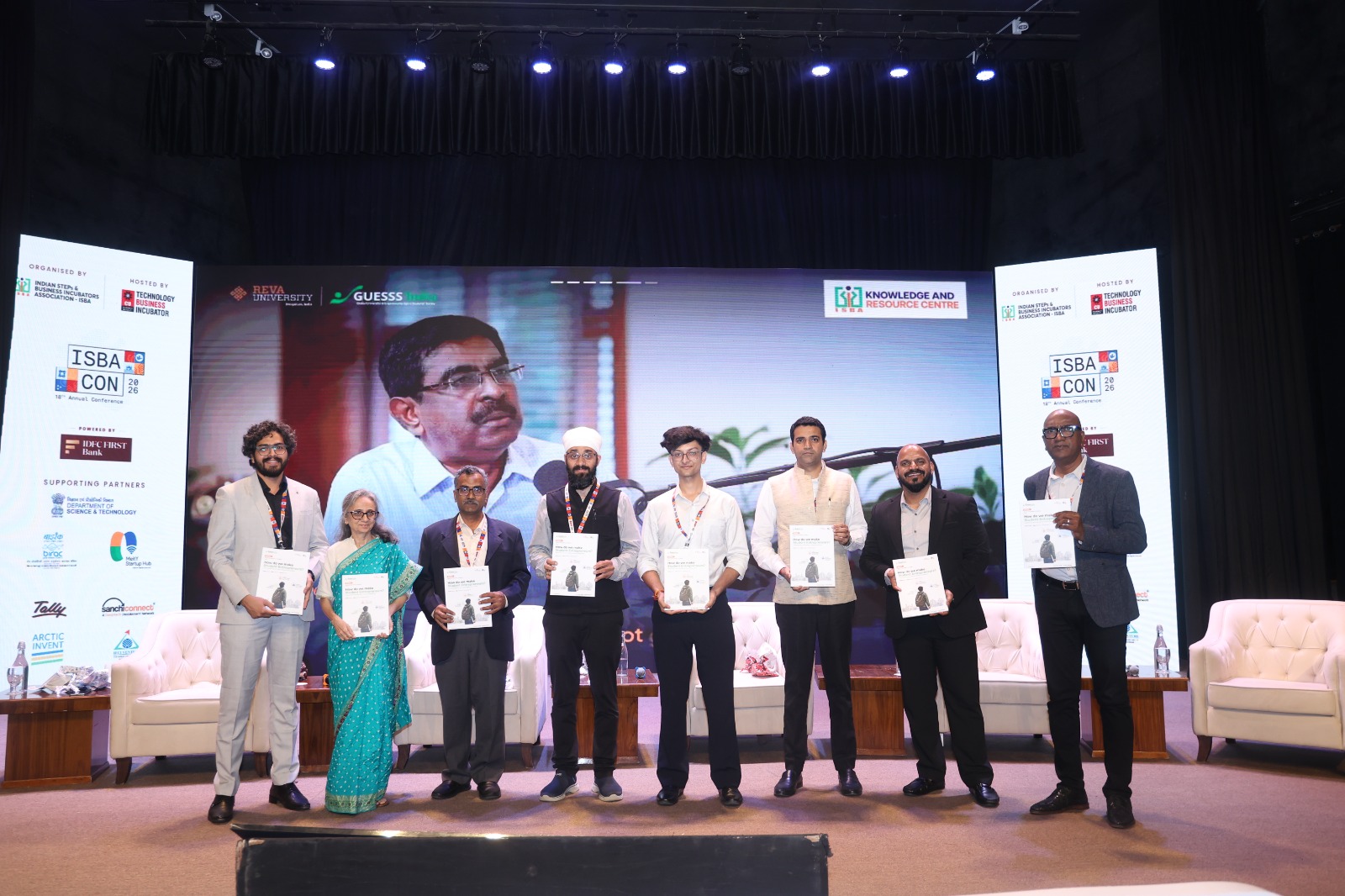
The report, "How do we make student entrepreneurs?", was launched on 9 October 2026 at ISBACON 2026 in Mohali. It is authored by Dr. Puran Singh and Prerak Sharma, and the survey was conducted between September and December 2025 with REVA University, Bengaluru, as National Partner. GUESSS India is the Indian chapter of the Global University Entrepreneurial Spirit Students' Survey, one of the world's largest research projects on student entrepreneurship.
Where more support can help
The report also points to where campuses can help more students take the next step. Half of Indian students know no entrepreneur beyond their parents (globally, one in three). Among students still building their venture, 10% have made a first sale. And while women plan to start a business almost as often as men, 45% of women who want to found have started, against 53% of men. "A university's task is no longer only to educate students for jobs. It is to educate them for enterprise, so that they create the jobs," said Dr. P. Shyama Raju, Chancellor, REVA University, the National Partner for GUESSS India 2025.
"Student entrepreneurship is central to how the School of Management thinks about management education: we want our students to build ventures and organisations, not only to manage them," said Prof. Anjan Swain, Chair, School of Management, IIT Mandi. "We are proud that this national study is led from our School, and we will use its findings to shape our own programmes."
"Entrepreneurship is about creating solutions, opportunities and impact," said Prof. Shyam Kumar Masakapalli, Dean, Sponsored Research and Industrial Consultancy (SRIC), IIT Mandi. "At IIT Mandi, we remain committed to an ecosystem where students are encouraged to seek opportunities and create them."
What the report recommends
The report asks universities, incubators and governments to:
-
Measure conversion, not intention. Track how many students who want to start a business actually start; today it is 51 in 100.
-
Put founders in students' path. Bring alumni founders, founder-faculty and student entrepreneurs into classrooms and hostels.
-
Push for the first customer, not the perfect plan. Reward first sales, registrations and prototypes over business-plan contests.
