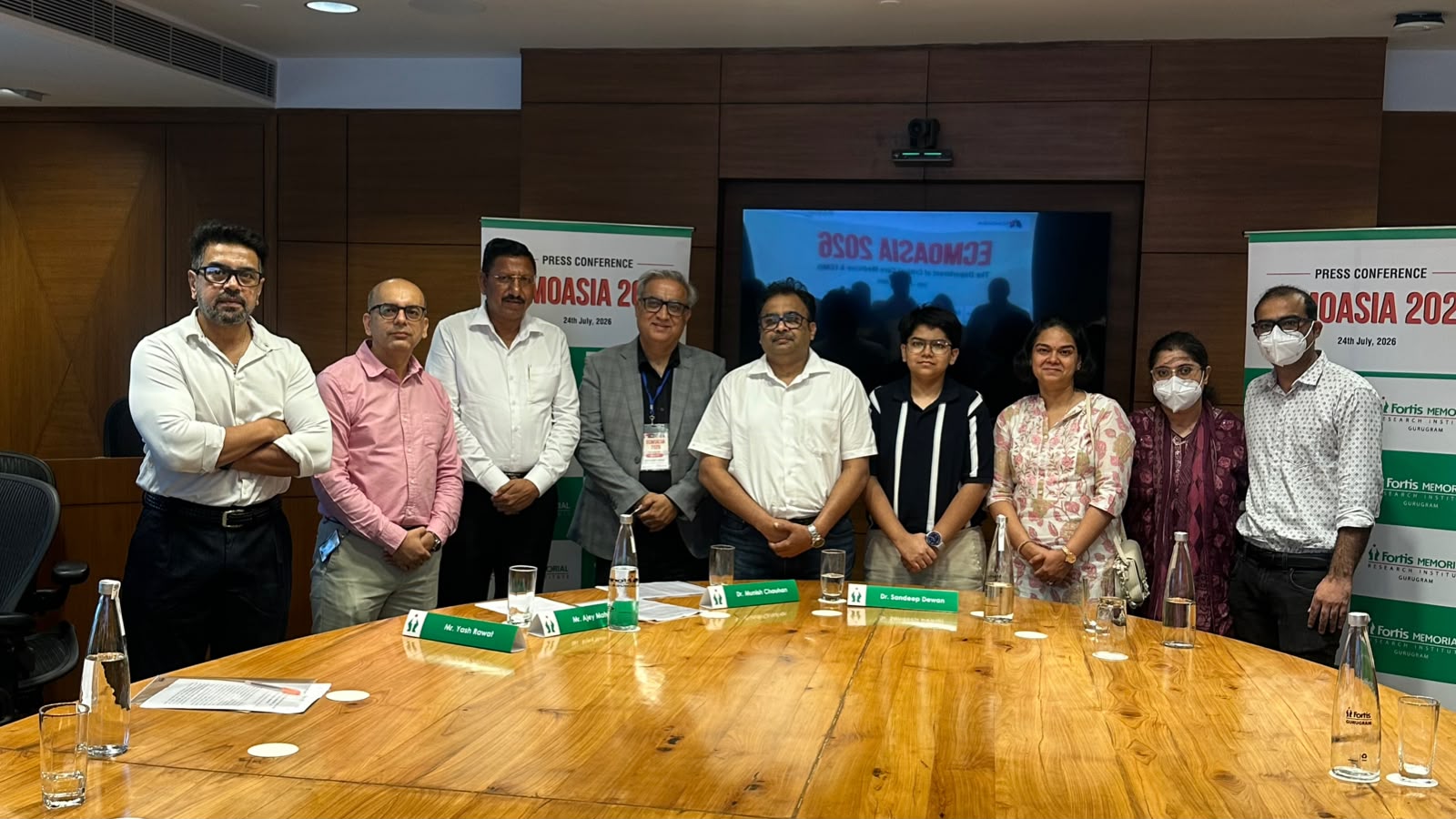
Gurugram, Aug 04: In a significant step toward strengthening awareness and advancing expertise in life-saving heart and lung support technologies, Fortis Memorial Research Institute (FMRI), Gurugram, is hosting ECMOASIA 2026 on 24–25 July 2026. The conference will bring together leading national and international experts to promote knowledge exchange, clinical innovation, and best practices in Extracorporeal Membrane Oxygenation (ECMO) care. A key highlight of the event is the showcase of Fortis's pioneering ECMO Retrieval Program, which has emerged as a benchmark in advanced critical care transport. Over the past two years, the Institute's rapid-response retrieval team has successfully completed more than 150 domestic and international ECMO retrievals, including complex, high-risk patient transfers from Phuket, Thailand. The program reflects Fortis's ability to deliver quaternary-level critical care beyond geographical boundaries, ensuring critically ill patients receive timely, specialized life support.
To illustrate the life-saving impact of ECMO across complex cardiac and respiratory crises, Fortis Gurugram highlighted three remarkable clinical recoveries that were successfully done by a multi-disciplinary team led by Dr. Sandeep Dewan, Senior Director & HOD – Critical Care, Fortis Memorial Research Institute (FMRI), Gurugram and Chairman – ECMO Program for Fortis Healthcare (Delhi NCR) and Dr. Munish Chauhan, Additional Director – Critical Care Medicine & ECMO, Fortis Memorial Research Institute, Gurugram.
The first case was a 40-year-old male from Gurugram, who presented in severe cardiogenic shock (a life-threatening medical emergency where the heart suddenly cannot pump enough blood and oxygen to meet the body's vital organs) following an acute heart attack. Despite emergency angioplasty and intra-aortic balloon pump (IABP) support, he experienced recurrent cardiac arrest and multiorgan distress. Veno-Arterial (VA) ECMO support was initiated alongside Continuous Renal Replacement Therapy (CRRT). The temporary life support allowed his heart muscle to recover, improving his left ventricular ejection fraction from 20-25% to 35-40%. He was successfully weaned off ECMO and discharged in stable condition.
The second case was of a 38-year-old male, who was admitted with severe septic shock, acute gastroenteritis, acute kidney injury, and acute septic myocarditis inflammation of the heart muscle), leading to severe heart failure Facing worsening metabolic acidosis and resistant arrhythmia, he was placed on VA-ECMO, within three days of optimized ECMO support, his cardiac function improved dramatically to 35-40%,. Following multidisciplinary ICU management, he achieved full recovery and was discharged home.
The third case was of a 46-year-old male suffering from Influenza A pneumonia and severe acute respiratory distress syndrome (ARDS). The patient’s condition was deteriorating on mechanical ventilation while at a city based hospital in Meerut. The FMRI Critical Care team travelled to Meerut, initiated Veno-Venous (VV) ECMO on-site, and safely transported the patient to FMRI Gurugram. Over a complex hospital course involving ultra-protective lung ventilation and specialized infection management, his lungs were given the time needed to heal. He was successfully decannulated from ECMO, weaned off the ventilator, and discharged in stable condition.
Despite ECMO being a revolutionary medical technology, there is a strong need for awareness among the general community regarding how ECMO can save lives when traditional ventilatory and medical therapies fail. The conference will address this critical gap through comprehensive scientific sessions, clinical case reviews, and dedicated chapters for clinical perfusionists and nursing teams on Extracorporeal Membrane Oxygenation (ECMO) as a life-saving intervention for acute heart and lung failure.
Highlighting the clinical imperative, Dr Sandeep Dewan, Senior Director & HOD – Critical Care, Fortis Memorial Research Institute, Gurugram; Chairman – ECMO Program, Fortis Healthcare (Delhi NCR) said, "ECMO acts as an external artificial heart and lung system, providing a crucial bridge to recovery when standard support is no longer enough. However, a lack of community awareness often delays decision-making. Through ECMOASIA 2026, our goal is to clarify complex treatment pathways for both the public and medical community so that families and primary care teams recognize ECMO early enough to save lives."
Dr Munish Chauhan, Additional Director – Critical Care Medicine & ECMO, Fortis Memorial Research Institute, Gurugram, said, "Transporting a patient on full life support requires extraordinary precision and specialized skills. Our success in stabilizing and rescuing patients facing multiorgan failure proves the immense power of advanced life support. Executing over 150 successful retrievals across India and internationally shows that geographical distance is no longer a barrier when every second counts."
Yash Rawat, Senior Vice President and SBU Head, Fortis Memorial Research Institute, Gurugram said, “At Fortis, our priority is to continually elevate emergency care standards by blending cutting-edge technology with medical expertise. Raising awareness about ECMO as an accessible, life-saving system empowers communities to make timely decisions during severe health crises. ECMOASIA 2026 reflects Fortis’s ongoing commitment to medical innovation and collaborative healthcare, bringing national and international leadership together to advance standards of care and improve patient outcomes globally."
