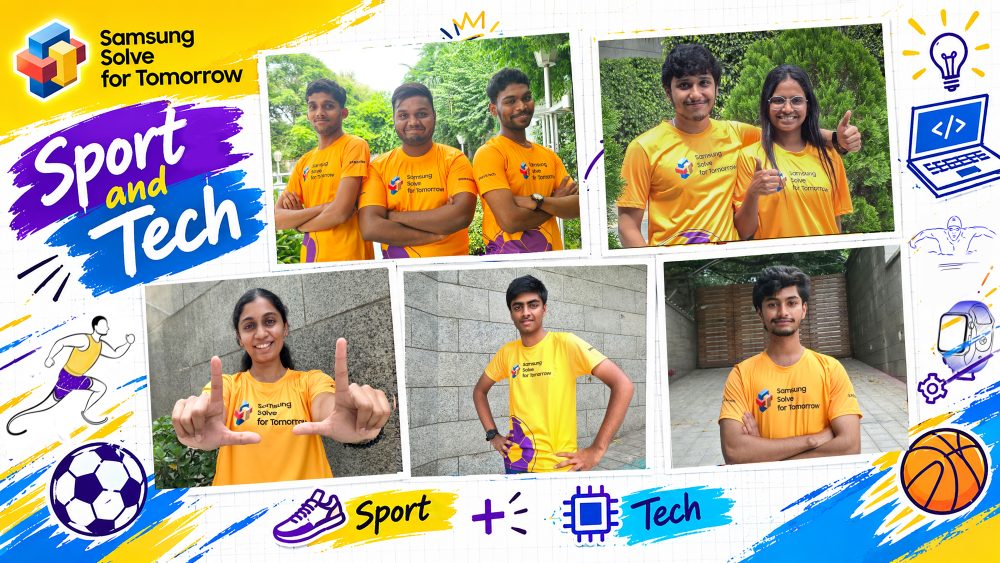
Caption: Samsung Solve for Tomorrow 2026 Top 20 Sport & Tech teams bringing technology and innovation to the future of sports
India – Sep. 23, 2026 - Can AI help discover India’s next para-athlete? Can a wearable help a visually impaired swimmer know when the pool wall is approaching? Can sensors make exercise safer for people with Parkinson’s or alert athletes to excessive physical strain?
Eight young innovators from Andhra Pradesh, Telangana, Tamil Nadu and Odisha are attempting to answer these questions through five technology-led ideas that have taken them into the Top 20 of Samsung Solve for Tomorrow 2026.
Their ideas span some of the most compelling challenges in sport and physical activity: AI-led para-athlete identification, independent navigation for visually impaired swimmers, exercise support for people with Parkinson’s and real-time monitoring of physical strain among athletes.
The eight innovators are Pasupuleti Ruthvik from Chittoor, Kolla Venkata Siva Surya from Visakhapatnam, Homanshika Reddy Pullagurla from Hyderabad, Vatala Harika and Ritesh Routray from Sundargarh, and Manoj Kumar Kasinathan, Jena R and Chriswin William D from Chennai.
Their progress to the Top 20 also reflects the geographical spread of this year’s Samsung Solve for Tomorrow. More than half of the participants in the Top 20 come from Tier 2 and Tier 3 cities, with finalists representing 18 cities across 12 states.
Five Ideas Trying to Change How People Play, Train and Compete
A Wearable That Warns Visually Impaired Swimmers Before They Hit the Wall
For visually impaired swimmers, knowing exactly when they are approaching the end of a swimming lane can be difficult and potentially lead to head injuries.
Pasupuleti Ruthvik, 21, from Chittoor, has developed Untethered, a wearable sensor system designed to provide real-time alerts as swimmers approach the pool wall. The idea aims to reduce dependence on manual cues from coaches and give swimmers greater independence during training.
Technology That Helps Visually Impaired Swimmers Stay on Course
Staying within a lane presents another challenge for visually impaired swimmers, who can drift sideways without visual reference points.
Kolla Venkata Siva Surya, 16, from Visakhapatnam, has engineered an assistive trajectory solution that provides real-time feedback when a swimmer begins to veer away from the intended path. The technology is designed to help para-athletes correct their trajectory and navigate competition pools more independently.
An AI Talent Scout for India’s Para-Athletes
What if promising para-athletes could be discovered using technology, even when they live far from established sporting networks?
Vatala Harika, 21, and Ritesh Routray, 20, from Sundargarh, are developing ParaSync, an AI-based platform designed to assess adaptive sporting techniques, identify promising athletes and connect them with professional coaching and competitive opportunities.
The idea addresses a grassroots sporting challenge: talent can emerge anywhere, while access to established scouting, coaching and competitive networks may not always be as widely available.
A Wearable Exploring Safer Exercise for People with Parkinson’s
In Chennai, Manoj Kumar Kasinathan, 21, Jena R, 20, and Chriswin William D, 20, are developing Rogue, a wearable device for people with Parkinson’s.
The team is exploring whether sensors can distinguish intentional movement from involuntary tremors, with the aim of supporting safer exercise and physical activity for people experiencing motor symptoms.
An IoT Wearable That Tracks Strain on an Athlete’s Spine
Homanshika Reddy Pullagurla, 21, from Hyderabad, is developing Somatrace, an IoT-enabled wearable designed to monitor spinal load among precision-sport athletes.
By tracking movement and load in real time, the system aims to give athletes greater visibility into the physical strain experienced during training and help them better understand how their bodies respond to different movements.
From Ideas to Prototypes — and Potential Ventures
For these young innovators, reaching the Top 20 marks the next stage in turning an idea into something that can be tested, refined and potentially scaled.
The eight innovators participated in an experiential Prototyping Programme conducted in collaboration with FITT-IIT Delhi, where they worked on strengthening their solutions through the Innovation Bootcamp and direct online mentorship from Samsung experts.
The programme encouraged participants to look beyond engineering alone. Working with mentors, they examined user needs, prototype development, go-to-market strategy, impact and scalability—helping them think about how solutions developed around real-world problems could potentially evolve into viable products and ventures.
Participants also visited Samsung Design Delhi (SDD), Samsung R&D Institute India – Noida (SRI-N), Samsung R&D Institute India – Delhi (SRI-D), Samsung R&D Institute India – Bengaluru (SRI-B) and Samsung’s Head Office in Gurugram, gaining exposure to Samsung’s approach to design, engineering, research and innovation.
Young Innovators from 18 Cities, One National Platform
A global problem-solving platform, Samsung Solve for Tomorrow encourages young people to use STEM—science, technology, engineering and mathematics—to address problems they see around them.
Now in its fifth edition in India, Samsung Solve for Tomorrow 2026 is bringing together young innovators across four themes: AI Living for India, Health & Education, Environmental Sustainability, and Sport & Tech.
Across the Top 20, participants are applying technologies including artificial intelligence, computer vision, sensors, voice technology and low-cost wearables to challenges ranging from literacy and accessibility to agricultural waste, pollution, neurological health and para-sports.
With finalists representing 18 cities across 12 states and more than half of the participants coming from Tier 2 and Tier 3 cities, this year’s Top 20 demonstrates how technology-led problem-solving is emerging from young people across India, including well beyond the country’s traditional innovation hubs.
The competition will now move towards its final stages. Four winning teams will collectively receive INR 2 crore in incubation grants, along with incubation support from FITT-IIT Delhi to further refine and validate their solutions and explore their potential to evolve into market-ready ventures.
