
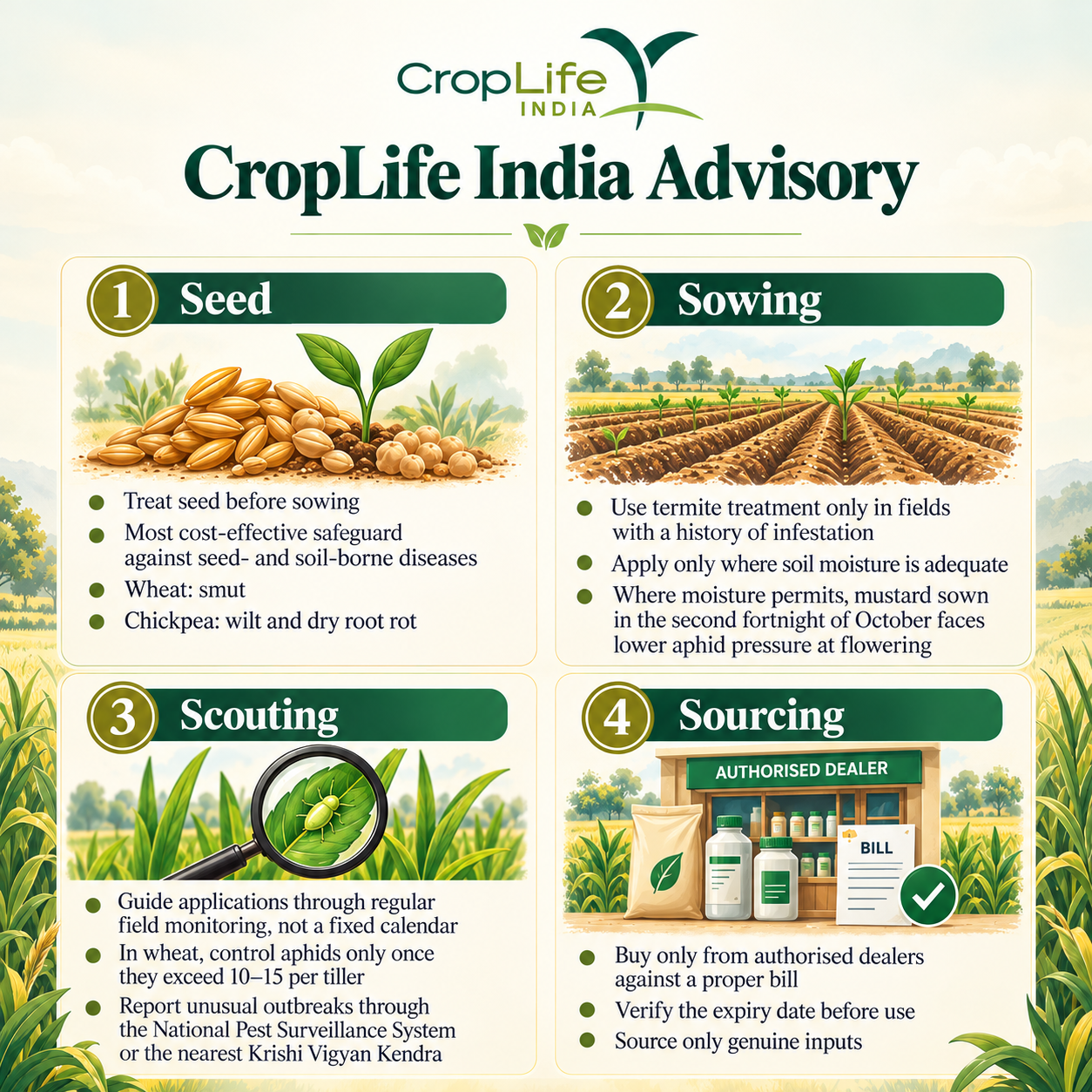
New Delhi, 13 October 2026: CropLife India, the apex association of leading R&D-driven crop science companies, has issued a four-point advisory for the Rabi 2026-27 season, spanning seed, sowing, scouting and sourcing, in the wake of the weakest monsoon since 2015. It outlines how the judicious use of crop protection products can help farmers protect their crops and manage input costs without compromising yields.
With member companies representing for about 70% of the Indian crop protection market, CropLife India works with farmers, the state agriculture universities and the Government on product stewardship and the responsible use of crop protection products. The advisory reflects established agronomic practice and is intended to help farmers make informed decisions at every stage of the Rabi crop.
On seed, the advisory identifies treatment before sowing as the most cost-effective safeguard against seed- and soil-borne diseases, including smut in wheat, which is aggravated by cool, moist conditions, and wilt and dry root rot in chickpea, which are aggravated by moisture stress and heat. On sowing, it recommends termite treatment only in fields, with a history of infestation and where soil moisture is adequate for the treatment to be effective, and notes that mustard sown in the second fortnight of October, where moisture permits, faces lower aphid pressure at flowering. On scouting, it advises that applications be guided by regular field monitoring rather than a fixed calendar; wheat aphids, for instance, warrant control only once they exceed 10-15 per tiller. Unusual pest or disease outbreaks may be reported through the National Pest Surveillance System or the nearest Krishi Vigyan Kendra. On sourcing, farmers are advised to purchase only from authorised dealers against a proper bill, and also to verify the expiry date before use.
The association also cautioned that a difficult season increases the risk of illicit products reaching farmers and reiterated its call for firm enforcement against unauthorised trade, including explicit regulation of online sales supported by licence verification and product traceability.
“The weakest monsoon in over a decade has altered the starting conditions for Rabi. Uneven soil moisture influences how crops establish, how pests and diseases behave, and how effectively inputs perform, which means the decisions farmers take in the coming weeks will shape the entire season. Farmers should reach out to the nearest agricultural research stations, KVKs or agriculture department officials for any support or guidance. This advisory is intended to help them make each of those decisions count, protecting the crop at its most cost-effective stage, applying products judiciously, safely and sourcing only genuine inputs. In a season such as this, precision is what safeguards both the harvest and the farmer’s investment,” said Durgesh Chandra, Secretary-General, CropLife India.
According to the India Meteorological Department, the southwest monsoon ended the season at 87% of its long-period average, with rainfall in the southern and eastern regions at 76% and 74% respectively.
The Centre's revised minimum support prices for Rabi crops include increases of Rs 675 per quintal for safflower, Rs 413 for rapeseed and mustard, Rs 390 for lentil, Rs 136 for barley, Rs 83 for gram and Rs 25 for wheat, with the steeper increases for oilseeds and lentil reflecting the policy emphasis on crop diversification. The Centre has also indicated that El Niño could bring excess soil moisture to some rainfed areas, and prolonged moisture stress to others, the very conditions the advisory seeks to help farmers manage.
